
Friday, June 3, 2011

Thursday, June 2, 2011
Bhalo

Designers all over the world have always been influenced by traditional cultures. Jessica Priemus is no different, however instead of just being inspired, she collaborates. Working with women in Bangladesh to create collections for her Perth based label Bhalo, Jessica shows us how exciting supporting artisans and disadvantaged communities can be.
How did Bhalo come about?
I travelled to Bangladesh to be a volunteer at a The Dhaka Project in 2008, where I met my now business partner Shimul, who was a manager of the project at that time. We were placed together as a team to create new designs for the project's sewing centre for disadvantaged women. The women had incredible skills, but little design knowledge, and no market for their products. We then decided to start our own label, using my skills as a designer, and his management skills and (local) experience with working with disadvantaged people. The Dhaka Project are still making my designs for the local market in Dhaka but for international garments we have since moved on to new producers.
Our first Bhalo project was a range of woolen scarves knitted by homeworkers in the outskirts of Dhaka. Soon after that we began working with Thanapara Swallows Development Society, which was established to provide employment for widows after their husbands were killed during the liberation war. Rather than aid, they wanted looms so that they could work and become self-sustainable. Today, the project employs over 200 people and funds free schooling and daycare for their children, as well as other community programs. To keep up with demand, we are also just about to start work with a new producer - Folk Bangladesh that provides new opportunities for tribal and indigenous groups in rural Bangladesh.

Can you tell us about the trips you go on for sampling and production?
About twice a year I travel from Australia to Bangladesh to create samples for the next collection and oversee production of the current collection. When arriving in Dhaka, I collect Shimul and we take the train 5 hours to the village of Thanapara in Rajshahi. We then spend a few weeks working very closely with the producers, who work with us on everything from pattern making to finished product.

What is the best part about going to the villages and working with the people who make Bhalo?
I love everything about going to the village. I love the train journey through the amazingly green rice fields and meeting up with all my friends and all the ladies once I get there. I could spend 1 month there and its still not enough time. We are always rushing to get work done - I really wish we had more leisure time! My goal next time is to find half a day to buy fishing rods and cycle down to the banks of the Ganges (or the Padma as it is known in Bangladesh) and join in with the dusk fishermen. Sometimes when we get a spare hour we go to the project kitchen and help the ladies there, lighting the fire in the traditional clay stove and making fresh roti!
What are the challenges you face?
Main challenges are probably the same as most small businesses, except throw in the added element of unexpected surprises. Something crazy is always happening in Bangladesh - whether it is man made or a natural disaster. This is why they use the word insha'allah a lot - meaning God willing - when talking about when the sampling or production will be done. The main reason why I travel there is to make sure I am there to answer any questions immediately, or just to help out. I always end up doing something manual like actually helping to embroider something or holding somebody's wriggling child - we are just really determined to get it done! We spend a lot of time with black feet and clothes drenched with sweat. I have had to abandon any dreams of maintaining a glamourous haircut!

You have amazing, vibrant prints and embroidery, where does your inspiration come from?
The Autumn/Winter 2011 collection's prints were inspired by traditional Jamdani patterns. Jamdani is this amazing Bengali traditional weaving technique used to make saris from a fine cotton muslin. The shapes and patterns are geometric and I thought that they would be really loved by the Australian market. I have a post about the weaving process on our blog...
I still dream of using actual Jamdani in clothing, but it is not a very durable fabric. It would be suited to something that you could wear once or twice without washing, like a wedding or formal dress... One day!
What do you hope for the future of fashion?
I hope that one day soon we will get rid of the assumption that cheap throwaway fashion is a right. You do not need 100 shirts. In many ways the fashion industry is designed to be unsustainable, with the constant stream of new fashion, new seasons, new styles. People feel unfashionable after one season. I hope that in the future we can get past this shallow attitude and start designing things that can be worn for years. Many fashion designers already do this, but high street fashion is still mostly just disposable.
I also hope that brands will get enough pressure to start being accountable for the conditions that they KNOW their workers toil in when they outsource their work to countries like Bangladesh. The sweatshops only exist for this work, and would most likely change given even slight pressure from the buyer. Sure, the factory owners in Bangladesh are also helping keep workers in these conditions, but what options do they have when someone is demanding a shirt for 30 cents and ready yesterday?
I think many of my hopes are definitely feasible and I hope to see them in my lifetime.

Whats next for Bhalo?
We will be launching our 2011-12 collection, called "Golden Year" online in August, and showing it off during Melbourne Spring Fashion Week in early September.
Currently we are designing and sampling our 2012 collection - think earthy clay colours with splashes of oxblood red and navy, batik prints and a focus on traditional embroidery.
We have just acquired 2 agents - one in Melbourne/Sydney and another in London/Dubai, so we hope to grow quite substantially over the next year, hopefully get more stockists in Australia and overseas.
Check out the Bhalo website here..the winter collection is AMAZING!
Read more...
Sunday, May 29, 2011
Skinny Nelson

While most of us were still living a life full of teen angst and turmoil, Jacqui Alexander was busy being the youngest designer stocked at Harvey Nichols. These days Jacqui has teamed up with Zachery Midalia for their label Skinny Nelson. Their latest collection holds onto youth, simple cuts circa "Smells like teen spirit", combined with chunky cable knits in Grape and Grey show that Skinny Nelson are more than just a basics label.
You accomplished quite a lot at a young age. What was it like being a designer in your teens?
It was pretty unreal, in the literal sense of the word, starting so young. So much of what I was doing was very unusual for someone my age and I guess, because I had nothing else to compare it to, I had no fear of failure which pushed me to just leap in and take a chance. The older I get the more I realise I have learned. Starting so young, there had been a massive learning curve very quickly. Whist I was always very fearless, there are definitely things I would've done a little differently or things that I would've taken more control of, but I'm so happy to have experienced so much so young, with time ahead of me now to work and act more effectively.

When you started Skinny Nelson how did you find the shift from solo to collaborating? How do you share roles?
It seamed pretty natural. I guess working alone I had always longed to be able to share the responsibility of sharing a business. It definitely frees up the creative channels to share that load.
Some of your basics are in organic fabrics, what inspired Skinny Nelson to lean towards a greener alternative?
Basically while I was working on my previous brand I came across the organic cotton and simply thought wouldn't it be great, wouldn't it be a cleanse, to wear something that not only looked and felt good contributed positively to the world as well.
What influenced your latest collection?
The current collection was inspired by nostalgic memories of skiing holidays. I chose the Swiss Alps as a point of reference because there is always an underlying Scandinavian aesthetic to each collection. So I included cosy cable knits, stripy long johns and a colour palette that reflected the silver snow and forest green trees of a ski trip memory.
It's often hard not to complicate things in order to strive for difference. How do you keep things fresh but simple?
I just try to keep designing for myself. As I grow and change and my style slightly alters, so do the ranges. That's how I keep them genuine and relevant I guess.
What's next?
We've jut launched our online store www.skinnynelson.com.au which will sell core collection pieces and eventually other products that we love. We're also going to be hosting a serious of intimate studio collection sales during the month of June every Friday at out studio in Collingwood which is pretty exciting.
Read more...
Tuesday, May 17, 2011
SOSUME

Simply put, Sosume is a label for the future,. With refined collections, high quality products and a transparent sensibility, we can easily see the reasoning behind each process and decision. Alex Trimmer, founder of the Australian based label offers his thoughts on the legality of careless creation, carpooling to work and the benefits of supporting local manufacturers.
Why fashion? How did SOSUME start?
It all started over in NY when I was finishing my degree as an exchange student. I felt there was a gap in the US market for “non-hippy” styled eco-friendly clothing. Everything I was seeing was fairly unimaginative when it came to colour palettes and fabric content. SOSUME was born to show that you can still wear cutting edge designs with amazing fabrics that actually wear and feel better than conventional fabrics. I launched the collection back home in Australia in late 2008.
What’s your opinion on contemporary fashion production?
If you’re referring to fast fashion, I think it’s awful and laws need to be made to stop it happening. Think of what an eighty-nine dollar nylon “leather” jacket does to a landfill and what it did to the local environment to get to the finished product.

How do you start a new collection?
A combination of what I see on the street mixed with traditional cuts and tailoring and ultimately, the fabrics I find. I’m limited to what I can use so I really have to find the fabrics first then think of the best ways to use them. The market for modern, sustainable fabrics is very small but growing so it’s a long process but well worth the effort. There are some remarkable materials out there.
What is your biggest source of inspiration?
As above. The biggest source is the fabric. I’ve always like men’s aesthetics but cut for a woman. I love traditional, timeless pieces and a quality make. When I find a fabric that I love, I try to think of all the different ways that it can be used to bring it to its fullest potential.
How would you describe your latest collection?
Easy, simple, breezy summer. I wanted to extend the jersey basics and introduce woven shirting. I like to build on previous collections and progressively add more and more complicated pieces. Its what makes me look forward to the next season!
Going back to the more ethical side of things..your label seems to have a sustainable element, why is this important?
Because it’s the only way forward. SOSUME proves you don’t have to wear a potato sack or sacrifice your style in order to wear something that is sustainable. The whole basics line uses micro modal, which only uses a tenth of the amount of water to produce each item than its cotton counterpart. The fabric feels sublimely soft, doesn’t effect the skin, will hold shape twice as long as cotton and also will hold its colour for twice as long too. It also is biodegradable so won’t fill up the dump at the end of the product life. This is a major concern with “fast fashion”.
You mention you garments are both organic and natural, roughly what percent is organic?
Actually, it depends on seasons. Some seasons I use organic cotton and organic wool among other natural or man-made fabrics while other seasons we just use man-made and natural. These new, modern man-made fabrics are actually the greatest thing the industry has seen as far as I know. They are created with the environment in mind and are designed to replace their harmful cousins such as rayon, viscose and others. The entire collection, doesn’t matter which season, is always made from only natural and organic fabrics. I just hope that the mills out there keep developing unique and beautiful fabrics to use!
Why produce in Australia? Why is this important and how does it affect your process?
Quality control. Simple as that. I also think it’s vital to support the industry that supports you. The manufacturing industry in Australia seems to be ailing but there are some great makers out there and it feels good to support them. It makes the process much quicker. If there needs to be an alteration, it’s easily done through a phone call and a visit. I couldn’t imagine the drama one would face when working with overseas factories. I like to work closely with my makers to develop the very best product.
What do you hope for the future of fashion?
For all labels to try and minimise their impact on the environment, whether it’s through their fabrics, their supply chains, their stock management, or even their employees’ carpooling to work! Every change for good makes a difference. It’s simple.
Check out Alex's website here, you can find out all his collections,fabric and production info..truly the way it should be...
Read more...
Saturday, May 7, 2011
Araks

Dreamy underwear in dusty blues, grape and cream create a nice alternative to the racy rouge and harsh blacks that lingerie habitually consists of. Araks is a label comprising of ready to wear and a simple elegant line of lingerie. Designed with comfort and beauty in mind, Araks Yeramyan tells us about her design process and the challenges of creating a luxury organic line.

When and why did you start your label?
I started my collection in 2000, designing underpinnings. The idea behind my designs is to capture elements of all things beautiful and reinterpret what remains with me. I have a strong commitment to creating collections that have women feel beautiful and confident, beginning with the most intimate and personal layer. This was the most relevant. Ready to wear was a natural progression,it was launched in 2006.
How did you learn the skills needed for a lingerie line?
Practice makes perfect. Lingerie has a lot of rules; you can’t just do anything you want. It has to fit well, make you look good, and be able to be worn underneath clothes with out too much distraction. Ready to wear, with fewer rules, gives room for endless possibilities and exploration. I enjoy the challenge.

Can you tell us how you go about creating collection?
I always start with the inspiration/mood and then go to color and silhouette. Once I am clear about that, it grows from there.
Who and what influences these collections?
It is always the same girl. I do get a lot of inspiration from artists; sometimes films, or other random elements around me. It can be anything really; it is where you take it.
The choice of color combination is quite unique, what inspires you?
I love color. I usually choose a color or two that I am drawn to from my inspiration. A lot has to do with my mood. When I'm designing a collection I am living with it for a while, each day I feel a bit different. At the end I always have to add in one color that throws the whole thing off.

What led you to a more sustainable option?
I was raised that way. That is how I live my life. When organic fabrics and practices became an option, it was only natural to go in that direction.
What are some of the pros and cons to going organic?
I think the pros are obvious; it’s the cons that make the whole thing complicated. If I could, I would have a whole collection of organic and/or environmentally responsible fabrics. It is a challenge to find Organic fabrics that are interesting, refined, and sophisticated for the person buying into luxury. I think as a society we don’t see a direct correlation as to why we should buy organic clothing. This makes it harder to grow an industry and have more sustainable options, although, I do feel we are becoming more aware.
Do you believe fashion reflects the issues of our times? If so how?
I think so. I can’t imagine anyone not being affected or influenced by their surroundings.
When you’re not working on your label what do you love to do?
I have two boys. I love to do anything they love to do.

You can check out Araks inspiring blog "Shaping Beauty" which documents all the lovely things that catch her eye here.
Read more...
Monday, May 2, 2011
New Andrea Crews collection-Undead

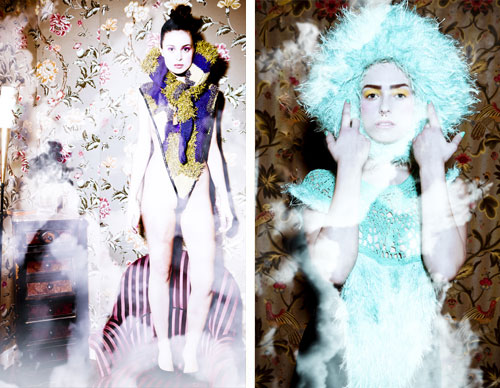
To read an interview with Andrea Crews click here
All pics by Hélèné Giansily, there are more coming...
All I can say is RAD! Read more...
Subscribe to:
Posts (Atom)