Thursday, March 3, 2011
Andrea Crews
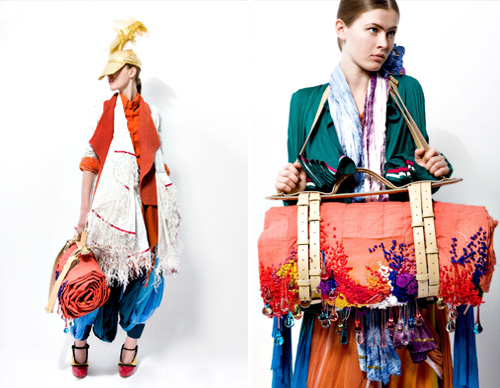
With the world over run by boring repetitious design and business structures, it’s easy to fall head over heels for Parisian collective Andrea Crews. Sustainability and clothing has never been so enjoyable.
How did Andrea Crews start?
In 2002 the collective was founded by Maroussia Rebecq for the recycling workshop exhibition at Palais de Tokyo.
What inspired Andrea Crews to have a social and ecological conscience?
It came from the exciting hunt of finding the treasure in the mountain of trash.It is a statement on the fashion industry, an example of how to recycle and how to make something new with waste.
You refer to your design process as a game with clothing codes. Could you elaborate on this?
It is all about attitude and body language which in turn creates the style. It's influenced by the adventures we are living and the people we meet. It's in between DIY, sculpture, art and play.
Andrea Crews collaborates with a lot of artists in different creative disciplines. Why is this important? How do you initiate your projects?
Because ANDREA CREWS is a collective experience, collaborating is a way to share the energy that feeds the creativity. We are showing an idea of a new system, a process, a life style. So it's important to share it with lot's of different people who can bring another vision to it.New projects are often coming up by themselves and if we think it's exciting it’s like ‘ let's go!’
Andrea Crews is anything but a stagnant and traditional label, how do you make it a viable business/collective?
We are selling our creativity & energy.
Do you have a favourite source of ideas and inspiration?
Our inspiration is always visually strong, such as tribal cultures, amazons, Japanese baby dolls but also Mormon people.
How does living in Paris, known for its traditional prêt a porter and couture houses affect your label and yourselves?
It’s nice, we also like pret a porter and it makes us different.
What next for Andrea Crews?
We just moved to open a new space in Belleville 25 rue de vaucouleurs 75011.It's our fashion workshop, creative studio and art gallery we opened with the exhibition of Neil Beloufa a young french artist, and we are gonna show more and more!
Above pics by Hélèné Giansily
Read more...
Wednesday, February 2, 2011
Karishma Shahani
Beetroot, ginger and turmeric are my guess when I look at Karishma Shahanis graduate collection. With the help of a magical organic dyer, Karishma has created a rainbow stained collection that puts the most high tech digital imaging to shame. Recently graduating from London College of Fashion, Karishma is currently collaborating with American artist Amy Sol creating a collection for Jhoohle, an NGO focused on empowering women in
Why fashion?
Just the simple fact of creating new things determines my passion for design.
Fashion in particular because it is so close to our daily lives. I love how contextual it is and how it is a key indicator of changes in society over time.It is a mode of self expression and is vital in defining individuals and in some cases beliefs.
What is your collection ‘Yatra’ about?
India: The land of dreams and romance, of fabulous wealth and stark scarcity, of splendour and rags, of palaces and hovels, of famine and pestilence, of genie and giants, tigers and elephants, the city, the jungle, of a thousand religions and two million gods, the birthplace of human speech, the epitome of legends and traditions.
The collection draws inspiration and elements from the multiple layers of India ’s vibrant culture that continuously create colourful, vivid and eclectic experiences for the onlooker. The colours are picked from traditional paintings of Indian Gods, and recreated through methods of dyeing. In its essence this collection is a reflection of the Indian lifestyle of re-interpretation of materials and their function at every step, always re-using and recycling, creating heirlooms that are passed down through generations.
Each garment is made with beauty, simplicity and versatility its core which lends it a multi layered and personality driven charm.
The designs combine a fusion of two extremes, making the collection experimental and unconventional, while being hinged on modern functionality.
Your designs are fantastically bright, what draws you to colour?
Its variety, its scope and my love for the beauty and life they bring to things.
How did you create such vibrant colours/dyes naturally?
Thanks to a very knowledgeable dyer.
Where does your inspiration come from?
Every where- Everything from cultures, lifestyles, history, people, places, traditions, colours and so on. I thrive on and feel inspired by all that I love and anything that catches my attention is my inspiration.
Does living between such diverse places as the UK and India influence your design?
Yes it does. The freedom of being able to reach where you want geographically is almost limitless. Being a person who thrives on influences from my surroundings both places are influences consciously or subconsciously.
What’s your opinion on contemporary fashion production?
With wide spread awareness and increasing environmental and social responsibility, contemporary fashion production is inching towards becoming more conscious. The credit of this influence that variates between extremes is dependent on the brand, the producer and the consumer.
Do you think aesthetics and ethics should be linked?
I think ethics should be linked to everything. It is good to think about who your aesthetics affect.
What next?
I am currently working on a Collaboration Project with American Artist Amy Sol to create a collection for Jhoole, an NGO working towards women empowerment in India . I hope to gain more experience working on individual projects alongside creating a new collection to set up a Design Label that fosters the longevity and revival of world art and crafts, automatically encompassing and promoting sustainable fashion.
What do you hope for the future of fashion?
I hope for a sustainable future of fashion that continues to become more aware of its power to change and assist changes in lives of all those involved.
Monday, December 20, 2010
Material By Product
Peach silk with shadows of chandeliers, a ceremonial union of hand stitches follows from collarbone to wrist. I cannot help but imagine myself in a low lit bar listening to jazz, playing with my long string of pearls.
It’s definitely not the era of dapper flappers. And I am not listening to jazz, I am listening to Chantal Kirby and Susan Dimasi explaining their latest collection and the unique production techniques of their fashion house Material By Product, showing that responsible practice can still be luxurious.
Chantal, a draper and Susan, a tailor started collaborating after studying fashion together at RMIT, Melbourne.
‘The process came naturally, we share common heroes that have strong languages -design houses like Chanel and (Marten) Margiela are our heroes, what defines them is a deeper commitment to fashion and a commitment to the community, maybe not how we live now but for how we live in the future.’
Material By Product came about after much deliberation on the existing structure of contemporary fashion production. Refusing to subscribe to the norm of impersonal mass production by using cheap fabrics and producing garments of poor quality, they devised an innovative system of cloth- making that encourages and supports fine craftsmanship. The label has established itself on collections of gracefully hand-crafted, practical and conceptual garments.
By creating a fashion house that dyes, prints and produces everything under the one roof, they have created a sustainable workroom. The pair have also re-invented traditional dress making, developing their own language. Cutting, marking and making are the three main grammatical points to their system. Their adaptation of a temporary tailor stitch and binding of silk-trimmed edges reminds the wearer and on looker that quality and luxury is not dead.
Before picking up the scissors there is a relentless interrogation of how to cut the garment. Emphasis is first put on the positive - what will become the main garment such as a dress or skirt and secondly, the negative -what will become an extension of the garment or the accessory such as their ‘Anti-scarf’. The Anti scarf is a unique item of adornment reliant on the style of dress. The result is not only a piece of clothing but an illustration of a defining aspect of their language. Susan describes the ‘The positive as traditional and the negative as an opportunity. This process of artisan production does two things at once creating rich outcomes and decorative cladding.’
A clue to their inspiration for their ‘decorative cladding’ habitually lies in their prints. Their textiles are often reinterpreted references of objects from different eras. The aforementioned chandeliers of a 1940’s ballroom play a key part in their Spring/Summer 10/11 collection. Each collection features a signature print design that is strategically placed or manipulated differently for each garment.
For me, what makes Dimasi and Kirby masters of their field are their complex garments made of one continuous piece of fabric. The dresses fit the body perfectly, molding and folding around the contours of the human landscape. Darts and draping a sign of gratitude to their heroes, the fashion house would be tough competition to its predecessors. Elaborate, yet logical once explained the mystery why this system is not still common practice prevails.
With many fashion houses turning to diversion ranges in home wares and the like, Material By Product have twisted the notion with creations commonly flowing into other objects such as their infamous Curtain Dress that can be worn conventionally or utilized as a blanket, screen and curtain. Conceptualisation continues with their refreshing fashion shows. Attempting to demonstrate the creative process, the model goes through the ritual of dressing in front of an audience in the exact same house the garments have been made in. In a world where the average T-shirt travels once around the globe before reaching us as consumers, for me the in-house show has a more pure and humble meaning.
Although very modest when it comes to making ethical claims, their meticulous process insures that ethical considerations are ingrained in their practices. Minimal waste just occurs naturally and so does the upmost respect to their employees. Their trading influences the nature of Material By Products’ production; the designers coin this as a part of their ‘strict economy’. Cutting to order, one garment at a time and trading through limited wholesale means minimal waste. Dimasi mentions the unimportance of ethical branding in her label, however, their construction ‘pursues zero waste’.
When questioned on their aim for their fashion house they did not focus on being ethical or green but hoped to be a responsible business, engendered with quality and ‘making damn good clothes’.
After leaving our first meeting, I am almost startled once I get back onto the ferociously loud and busy modern street. Although my preferred existence is not full of wistful eves in peaches and cream, I can’t help but wish I had the lifestyle of a lady who could don a Material By Product garment every day of the week.
Endangered, craftsmanship and quality is fading and it is refreshing to see such a naturally defiant label.
Read more...
Wednesday, December 15, 2010
Lime Drop
In a city covered in clouds and cool breezes, Clea Garrick and Nathan Price have found a home for themselves and their label Lime drop. After slowly migrating south to Melbourne from sweltering northern capitals, definitive skies have always hung overhead.
Tempestuous clouds wrap around you in the form of floating silk and great winds are caught in merino cardigans. Texture and prints seem to share focus with plays on movement and magnitude. Limedrops’ men and womenswear lines seem to focus on quality textiles. This focus on interesting materials bleeds into their accessories which are made from material off cuts and wood carvings. The broad range of products suggests the young design duo to be nurturing a healthy creative and resourceful business.
Textile prints have always been a strong element in the collections. Often inspired by Australian and far away landscapes they have progressed from screen prints to elaborate digital cloud formations and heavily patterned knits. All of which are produced locally. Unlike most Australian labels the pair have made a conscious decision that their clothes are made in their new home town. Working closely with Melbourne knitters and printers enables the pair build a strong dialogue with local manufacturers encouraging developments in design as well as ensuring quality and control. Manufacturing in Australia enables Limedrop to reduce the carbon miles of the clothing, and also support a suffering Australian industry. The majority of clothing designed in Australia is manufactured off shore. It’s a humbling feeling wearing clothing that was created in our own ‘backyard’ instead of a huge factory in an anonymous town.
Limedrop is collaboration between Nathan and I. Our strengths lie in different areas and we can contribute different things to make the playful label.
Why produce locally? Why is this important and how does it affect your process?
We produce Limedrop in Melbourne. It means that we can have more control over the process and involvement in the end products. We have been working with great manufacturers here and designs can come out of talking to them or seeing new developments in knitwear or machine capacities.
What’s your opinion on contemporary fashion production?
Fashion is becoming faster and the production lines have changed to accommodate this. Sometimes the market reacts in the opposite way to the way we are heading.
We play with proportions and volume within Limedrop design and this means that we need to be more thoughtful with how we use our fabric. Often times we will have two designs that can fit in together when they are cut. For Autumn Winter 2010, we have a range of merino wool three colour jacquard jumpers, cardigan and scarves knitted in Melbourne. The off cuts from these designs are being made into cloud knit eye masks.
What are your thoughts on the nature of fashion in relation to consumption?
Fashion has always been hand in hand with consumption and as the speed of fashion increase so does consumption.
Should aesthetics and ethics be linked?
Ethics should be part of all aspects of life.
Does geography affect you?
Australia is a great place. The distance to the rest of the world can be a curse and a blessing.
What next?
The future is exciting and full of lots of plans for the label.
We hope that the future of fashion is that we continue to push the boundaries and value the important things.
www.limedrop.com.au
Read more...
Subscribe to:
Posts (Atom)